
History of Agartala: Kingdoms, Heritage and Timeline

Rahul Garg
January 23, 2026
Discover the history of Agartala through its Manikya dynasty roots, royal monuments, political transitions, and modern heritage-focused city timeline.
Introduction to the History of Agartala
Agartala, the capital of Tripura, is one of Northeast India's most historically layered cities. It combines royal legacy, administrative transformation, migration-era change, and living cultural traditions in a compact urban geography. Travelers often visit Agartala for palaces and temples, but the deeper value comes from understanding the city's historical timeline, especially its link with the Manikya dynasty and the wider Tripura kingdom.
If you are researching the history of Agartala, the most useful approach is to read it in phases: pre-modern kingdom roots, court and palace era, colonial interactions, merger with India, and post-statehood modernization. This guide follows that structure and connects each phase with places you can actually visit today. For trip logistics and sightseeing order, combine this with places to visit in Agartala before planning your route.
Quick Timeline of Agartala and Tripura
| Period | Key Historical Shift | Why It Matters |
|---|---|---|
| Pre-modern kingdom era | Tripura ruled by Manikya lineage | Forms Agartala's royal foundation |
| 19th century transition | Administrative focus shifted toward present Agartala zone | Set up modern capital structure |
| Late colonial period | Modern institutions and planning expanded | Urban growth accelerated |
| Post-1947 | Tripura's political integration into India | State structure changed permanently |
| 1972 onward | Tripura statehood and democratic development | Modern Agartala governance shaped |
This phase-based model helps avoid fragmented reading of Agartala's past.
Manikya Dynasty and Royal Agartala
The Manikya dynasty is central to Agartala Tripura history. For centuries, Tripura's political and cultural direction was shaped by Manikya rulers, whose legacy still appears in architecture, ritual spaces, and city identity. While the kingdom's earlier capitals and centers shifted over time, the Agartala region became increasingly important in later phases of royal administration.
Royal patronage influenced education, temple culture, court arts, and civic construction. The most visible public memory of this period survives in palace architecture and related cultural institutions. Even modern city narratives in Agartala continue to reference Manikya-era symbolism.
- Historical role: long-duration monarchical governance across Tripura.
- Cultural role: patronage of architecture, festivals, and court culture.
- Urban role: transition toward organized capital-centered administration.
Ancient and Early Urban Origins
Before becoming a modern capital city, the region that developed into Agartala belonged to a broader historical landscape tied to tribal communities, evolving kingdoms, and cross-regional movement with Bengal and neighboring hill zones. Historical memory in Tripura includes both written royal chronicles and oral traditions preserved in communities.
This mixed record is important because Agartala's identity cannot be reduced to only one political period. It emerged gradually through layered transitions in settlement, governance, and regional connectivity. That is why the city's heritage is distributed across temples, palaces, old neighborhoods, and local narratives rather than one single monument core.
Medieval to Early Modern Political Context
Tripura's kingdom structures evolved through diplomacy, conflict, alliance-building, and administrative adaptation. During this phase, rulers balanced hill and plain interactions while protecting territorial interests. Court culture, temple building, and administrative specialization developed further, shaping the historical continuity that later fed into modern Agartala.
This period also mattered for language and cultural exchange. Regional interactions with Bengali literary culture, local tribal traditions, and court institutions together shaped a hybrid heritage profile that remains visible in Tripura today.
Colonial Era and Administrative Transition
The colonial period did not erase royal structures immediately; instead, it introduced layered shifts in governance, diplomacy, and infrastructure. In and around Agartala, this phase saw increased bureaucratic ordering, transport-linked growth, and expanded public architecture. Palace-centered authority continued, but the administrative environment became more complex under changing regional politics.
Urban planning patterns, institutional spaces, and documentation practices expanded in this period. As a result, Agartala's city-form began moving closer to a modern administrative capital model, while still retaining royal symbolic power.

Integration with India and Statehood Milestones
The political transformation after Indian independence is a defining chapter in the history of Agartala. Tripura's merger with India in 1949 changed the constitutional framework of governance. Later, Tripura became a Union Territory in 1956 and achieved full statehood on 21 January 1972. These shifts transformed policy-making, infrastructure planning, representation, and public administration.
| Year | Event | Impact on Agartala |
|---|---|---|
| 1949 | Merger of Tripura with India | Political framework shifted to Indian Union governance |
| 1956 | Union Territory phase | Administrative restructuring intensified |
| 1972 | Tripura became a full state | Agartala expanded as state capital hub |
These transitions are critical for understanding modern city development, including education, transport, and urban institutions.
Historic Monuments that Explain Agartala's Past
Ujjayanta Palace
Ujjayanta Palace is the most iconic historical landmark linked to Agartala's royal chapter. Beyond its visual appeal, it represents palace-era statecraft and the transition from courtly authority to public heritage interpretation.
Neermahal (Wider Tripura Heritage Circuit)
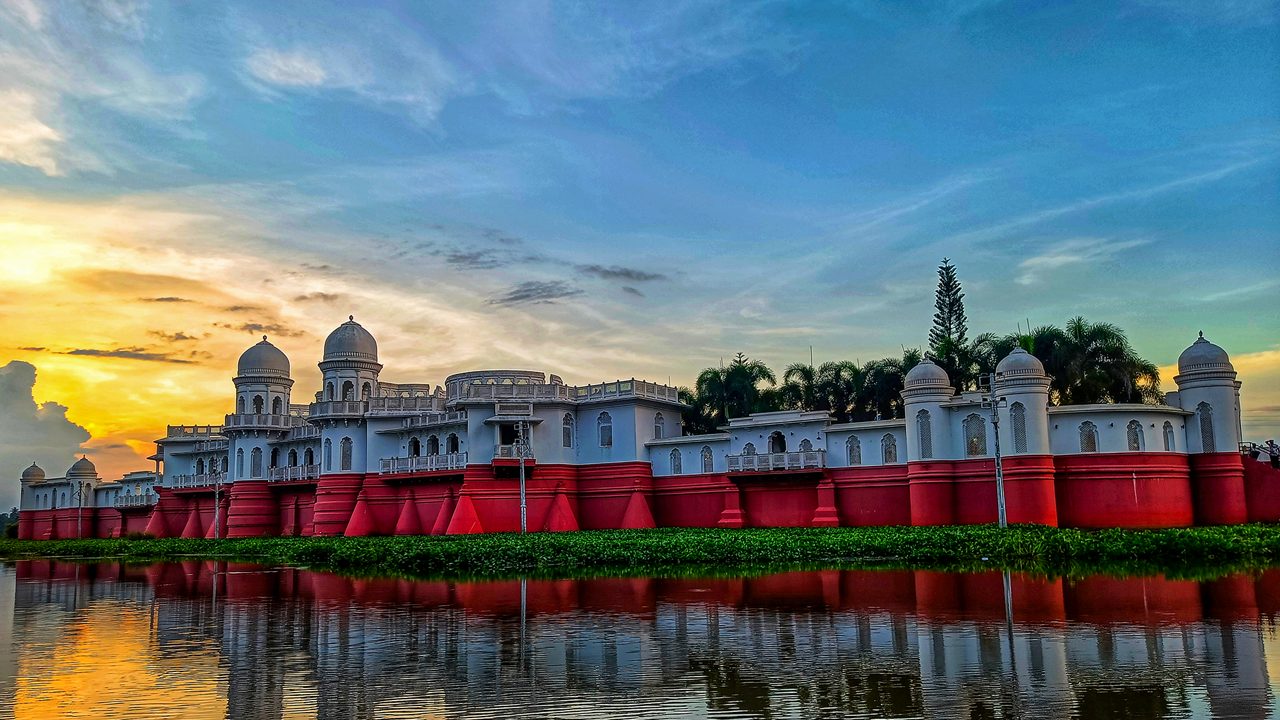
Though outside central Agartala, Neermahal is often included in historical reading of Tripura's late royal architecture. It reflects how royal aesthetics extended into landscape-based leisure architecture.
Jagannath Temple and Other Religious Sites
Temple spaces in Agartala preserve continuity between royal patronage and living religious practice. They are important for understanding how governance, devotion, and social identity interacted in the city.
For city-wide stop planning, use Agartala places guide to sequence monuments and neighborhoods efficiently.
Cultural Heritage and City Identity
Agartala's cultural identity evolved through coexistence and adaptation. Royal institutions, tribal traditions, Bengali literary influence, and modern state institutions all contributed to the city character. This layered structure is why Agartala feels historically grounded but administratively modern.
- Language and literature: multilingual cultural space with strong literary activity.
- Festivals and rituals: reflect both royal-era continuity and community practices.
- Craft and performance: local arts remain part of identity expression.
This cultural layer is essential when reading historical monuments, because sites are still embedded in living civic life.

Agartala in the World War and Late Colonial Context
In the broader northeastern theater, the World War period increased strategic awareness across nearby regions, affecting transport, administration, and security thinking. Agartala's local governance and planning also absorbed lessons from wider wartime-era infrastructure shifts in eastern India. While the city was not a single front-line battlefield narrative, the period influenced how administration and connectivity were prioritized in later decades.
This is one reason post-independence Agartala was able to scale as a state capital: the institutional habit of strategic planning had already deepened during earlier transitional decades.
Modern Development Without Historical Erasure
Modern Agartala has expanded through roads, education institutions, market growth, and administrative services. Yet key historical structures continue to anchor city memory. The best way to experience this balance is through a route that mixes palace history, neighborhood observation, and local food culture.
A practical history-focused day can include Ujjayanta area, heritage streets, temple stops, and cultural pauses. Add local cuisine breaks through places to eat in Agartala and relaxed coffee stops from cafes in Agartala.
Archives, Museums, and Historical Memory
To understand Agartala beyond monument photography, spend time in museum-style and archive-linked spaces where available. These places provide context on royal administration, social transition, and post-merger governance. Even short exhibit sections can help you read monuments better by connecting dates, personalities, and policy shifts.
A strong method is to do monuments first and exhibits second. That way, carvings, palace halls, and street layouts become easier to interpret. This two-step approach improves historical depth without requiring specialist academic preparation.
Key Dates You Should Remember
- 1949: Tripura's merger with India changed the constitutional status of governance.
- 1956: Union Territory phase deepened institutional restructuring.
- 21 January 1972: Tripura became a full state, reinforcing Agartala as the political center.
Remembering these dates helps connect monument visits with state formation. When you stand at palace-era sites and then walk through modern administrative Agartala, you are effectively seeing pre-merger and post-statehood history in one city map. This continuity is what makes Agartala especially valuable for learners, not just tourists.
Suggested Heritage Walk in Agartala
Half-Day Heritage Circuit
- Start at Ujjayanta Palace precinct
- Move to nearby historical streets and religious landmarks
- Pause at local market and culture zones
Full-Day Heritage and City Circuit
- Morning: palace and institutional heritage belt
- Afternoon: extended city history stops
- Evening: food and public-space culture walk
This format keeps the day manageable while covering both political history and living culture.
Travel Tips for History-Focused Visitors
- Begin early to avoid heat and to get better photography light.
- Use local guides at key heritage sites where interpretation is available.
- Verify opening hours for museums and palace sections before departure.
- Keep one flexible buffer slot for traffic or local event diversions.
- Respect active worship spaces while exploring historical religious sites.
For non-heritage add-ons, you can include shopping in Agartala and nightlife in Agartala in the evening block.
Conclusion
The history of Agartala is best understood as a long continuum: royal foundations, administrative transition, integration with India, and modern state-capital growth. The Manikya legacy remains visible, but the city is not frozen in its palace past. It is a living urban center where historical memory and current life interact every day.
If you explore the city through timeline-based stops rather than random sightseeing, Agartala becomes one of the most rewarding heritage experiences in Northeast India, especially for travelers who value context-rich urban history over checklist tourism for serious readers today.

Location
Frequently Asked Questions
Q1.What is the history of Agartala?
Q2.When was Agartala established as a capital center?
Q3.What is Ujjayanta Palace known for in Agartala history?
Q4.Who built Neermahal in Tripura's royal period?
Q5.Can travelers visit historical palace sites in Agartala?
Q6.How did Agartala get its name?
Q7.How did colonial rule affect Agartala?
Q8.When did Tripura become a full state of India?
Recommended For You
Best Cafes in Agartala: Coffee Spots, Ambience & Food Favorites
Discover the best cafes in Agartala with practical tips on coffee spots, budget planning, timing strategy, and city routes for a smooth cafe experience.
Places to Eat in Agartala: Best Restaurants, Cafes & Local Food
Explore places to eat in Agartala with Tripuri cuisine, city restaurants, market snacks, sweet shops, and practical food route planning tips.
Places to Visit in Assam: Itinerary, Best Time & Top Attractions
Plan your Assam trip with practical route circuits, day-wise itinerary ideas, seasonal timing tips, and budget-friendly travel planning.
Never Miss an Adventure
Get the latest trekking guides, travel tips, and exclusive offers delivered straight to your inbox.
